🏅 Fields Medal 时刻
1
犀利
"I realized I have like almost 100 unread emails... I feel that now I'm getting really famous on Chinese internet, which is, I don't know how to say about this."
开幕式当天整个上午被占满,回到酒店才发现将近 100 封未读邮件。获奖后被中国互联网刷屏,他自己还在消化这个突然到来的名声——那句 "I don't know how to say about this" 后面跟着的是一段停顿。
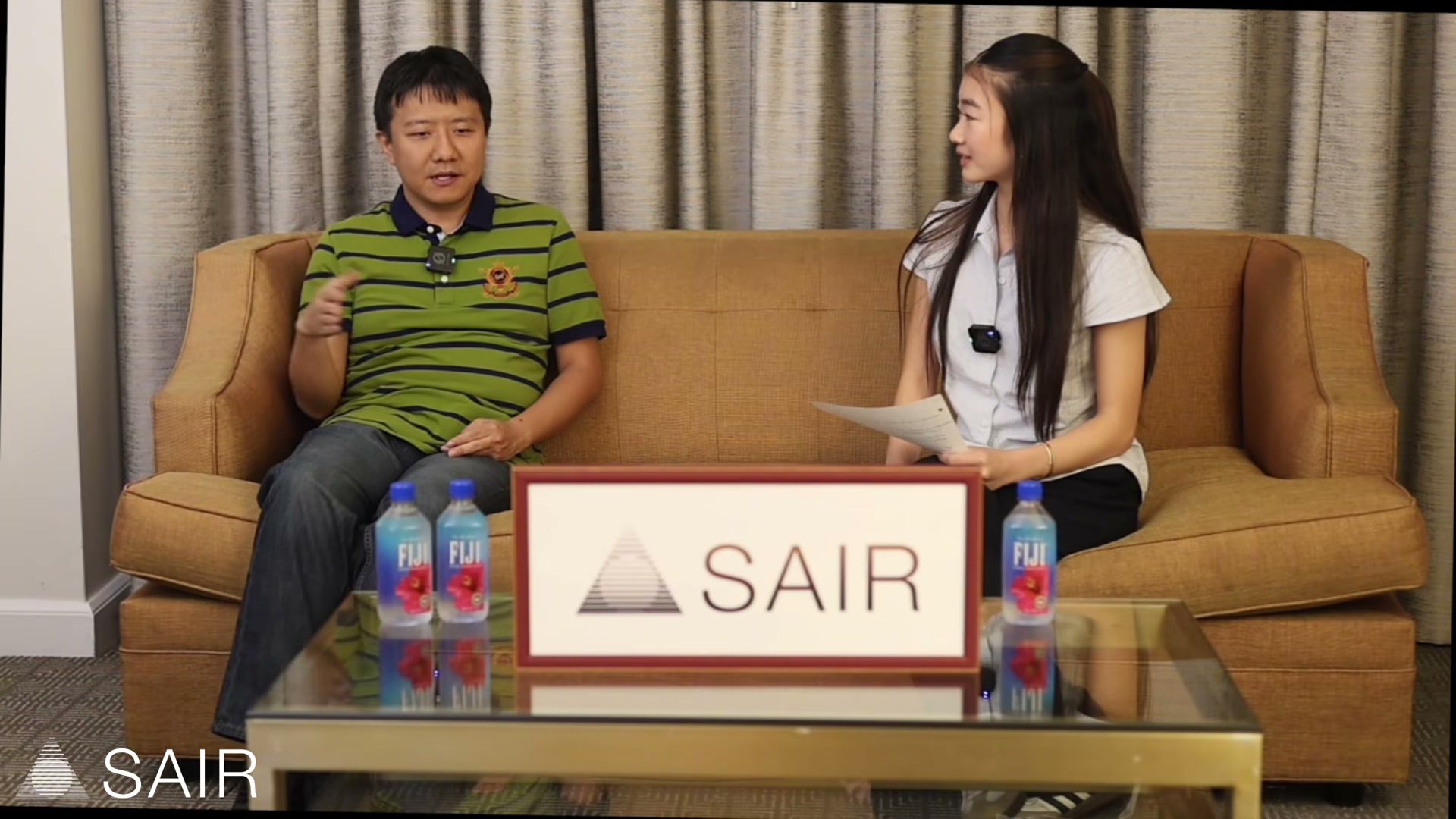
2
洞察
"Usually I don't think about these things because these things you cannot control."
2024 年完成工作时他确实认真想过"也许有戏",但真正得知是 2026 年 1 月。临近颁奖有点紧张,"不太多"。一个菲尔兹奖得主的心态标尺:控制不了的事,就不去想它。
🧮 从粒子到流体:125 年的难题
3
技术
"You start from this huge system and you try to find this effective equation... which will be the Boltzmann equation. And then with the second limit, you get to this familiar fluid equation."
希尔伯特第六问题的核心是在不同尺度之间架一座桥。起点是微观粒子——牛顿定律、有限次碰撞,规则简单得几乎朴素;第一次取极限得到刻画统计行为的玻尔兹曼方程,第二次取极限才落到我们熟悉的宏观流体方程。他形容自己做的事就是 building this bridge between the different scales。
4
洞察
"You don't need to keep track of every single trajectory... you only need to keep track of what happens with high probability. And that actually simplifies things a lot."
随机性最反直觉的地方:不确定性不是障碍,反而是简化的钥匙。你不必追踪每一条轨迹,只需要盯住"大概率会发生什么",把那些 exceptionally bad cases 放掉。代价是你得另外证明这些坏情况确实极少发生——而长时间尺度上随机性怎么传播,他说至今仍是很难的问题。
🤖 AI 与数学家
5
犀利
"There was a lemma... I spent like five days, I found a proof, like four page proof, but then I asked GPT and it gave a one page proof within one hour."
这是他第一次在研究里认真用 AI。困了他五天、写出四页的引理,GPT 一小时给了一页。结局有个转折:因为他问的是一个特殊情形,那个证明没能推广,最终没写进论文——但里面的想法 "very useful"。
6
技术
"If we can have a framework that allows to divide this project into individual sub-lemmas that is relatively short, then AI can probably help us prove it."
他对 AI 辅助数学研究的核心构想:AI 现在能证的是"短定理",那就设计一套框架把大项目切成一批相对短的子引理,让 AI 逐个攻克。他的原话是这会 significantly accelerate the progress——甚至让目前做不到的事变成做得到。
7
犀利
"It's not like we're not competing against AI. We are working with AI to achieve things that we previously cannot achieve."
全场最清醒的一句表态。他明确拒绝"助手"这个框架本身,也拒绝"取代"这个框架:两者共享同一个错误前提,把 AI 和数学家放在同一根能力轴上比大小。
8
洞察
"If AI can prove some more theorems, then we will rely on those theorems as well. And we will build our arguments on those theorems, provided we can understand them."
面对"AI 能写出更长更复杂的证明,那数学家干什么"这个担忧,他的回答很朴素:我们现在就依赖别人证过的定理。AI 证出来的定理会变成新的基础工具,我们照样在上面搭论证、继续往前推——前提是那个 provided we can understand them。
🔭 下一个前沿
9
技术
"The most famous problem here will be the Yang-Mills construction... it's a so-called critical problem."
他把量子场论(尤其 Yang-Mills 构造)看作下一个重大前沿。理由是方法论上的:Yang-Mills 难,难在它是"临界问题",而他一直在做的 wave turbulence 在某种意义上也是临界问题。所以他期待自己的方法用得上——"still pretty far away",但已经有了路线图和最初的基础工具。
10
洞察
"In finite dimensions, your point is determined by finitely many coordinates. Now in infinite dimensions, your point is a function."
高中生主持人问"无穷维你到底怎么想象",他给的答案回到泛函分析的起点:把一个函数看成一个点,把函数的集合看成一个空间。非线性情形下确实复杂得多,但这正是物理学深层结构必须用到的语言。
11
路径
"I was in this IMO and I got a gold medal. At that time, I was thinking that maybe math is the correct thing for me to do."
从 IMO 金牌到菲尔兹奖,路上没有戏剧性的顿悟时刻。他说得很平:I don't think there is a particular moment where I decided on that——IMO 之后去学了点大学数学,进了大学继续享受做数学,于是慢慢意识到这就是想做的事。是渐进的确认,不是灵光一闪。
⚖️ AI 与数学家的分工
12
🧠 数学家仍然不可替代的
- 判断哪些问题值得问
- 理解和推广证明
- 构建宏观框架和路线图
"I wouldn't say it's some helper or assistant or replacing mathematicians or anything. I don't want to view in this way."
他拒绝的不只是"AI 取代数学家",也包括"AI 是助手"。两种说法都把 AI 和数学家放在同一根能力轴上比大小。他的实际用法更接近:各自做各自擅长的那一半,然后拼起来。
"We are working with AI to achieve things we previously cannot achieve.
As long as we can do this, there is nothing to worry about."
— Yu Deng, 2026 Fields Medalist