一、100 封未读邮件:得奖这一周
获奖消息今年 1 月才知道。在此之前,他刻意不去想这件事。
访谈录于 2026 年 7 月费城 ICM 闭幕后不久。开场第一个问题是"这一周过得怎么样",回答里没有豪言:
It's a really busy week. I remember on the day of the opening ceremony, I had the whole morning completely occupied. And when I finally got back to my hotel, I realized I have like almost 100 unread emails.
这周真的很忙。我记得开幕式那天,整个上午被排得满满的。等我终于回到酒店,才发现自己有差不多 100 封未读邮件。
接着是一句更实在的观察,说完他自己也笑了:
I feel that now I'm getting really famous on Chinese internet, which is — I don't know how to say about this.
我感觉自己现在在中文互联网上真的挺出名的,这个……我不知道该怎么说。
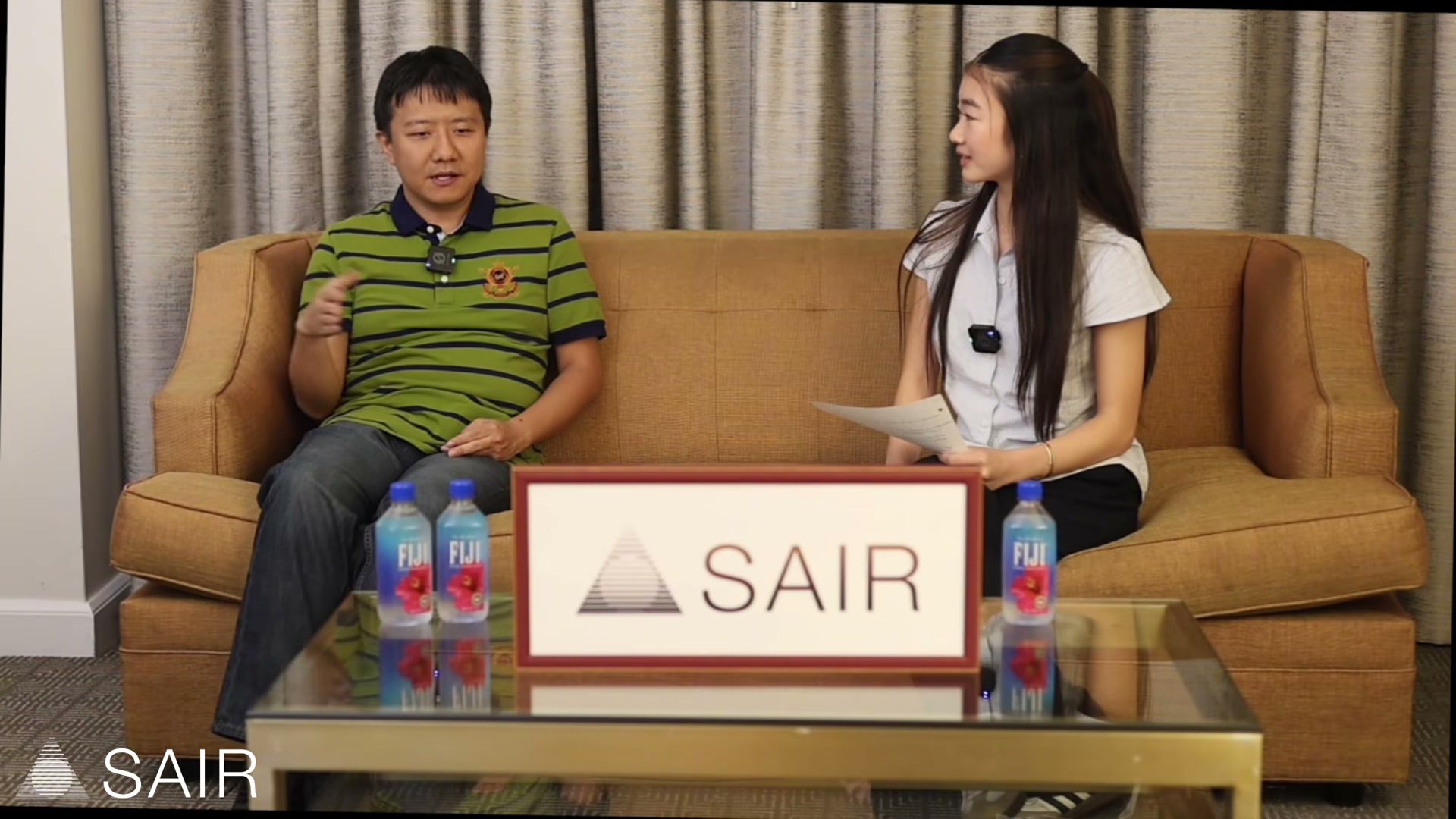
被问到有没有预料过菲尔兹奖,他的回答分成两段。2024 年论文完成时确实动过念头,但真正得到消息是今年 1 月:
I maybe had some vague thoughts about it years ago. At one time I was really seriously thinking about it in 2024, when we finished our work. But really I learned this only in January this year. Usually I don't think about these things, because these things you cannot control.
几年前我可能有过一些模糊的念头。2024 年我们完成那项工作的时候,我确实认真想过。但真正知道是今年 1 月。平时我不太想这些事,因为这些事你控制不了。
主持人接着问他是怎么从学生走到今天的。这里也没有戏剧性的转折点:
When I was in high school, I was in this IMO and I got a gold medal. At that time I was thinking that maybe math is the correct thing for me to do. I don't think there is a particular moment where I decided on that, but it was kind of gradually — after the IMO I decided to learn some college math, and then I went to college and I keep enjoying doing math.
高中时我参加了 IMO(国际数学奥林匹克),拿了金牌。那时候我在想,数学也许就是适合我做的事。我不觉得有某个特定的时刻让我下定决心,它更像是逐渐发生的——IMO 之后我开始学一些大学数学,然后上了大学,一直乐在其中。
整段访谈里他描述选专业、选问题、用 AI,语气一直是"逐渐"。
二、125 年的桥:从台球到流体
希尔伯特第六问题追求的是一条严格的推导链:从"一堆粒子按牛顿定律互相碰撞",一路推到"流体方程"。
主持人请他用外行能懂的话解释自己证了什么。他的版本是这样的:
It concerns this picture of the fluid or the gas that is made up by these tiny particles, tiny molecules. What you want to do is connect the behavior of these particles — which is relatively simple, you have Newton's law, you have interactions — you start from this huge system and you try to find the effective equation that governs the statistical behavior of these particles, which will be the Boltzmann equation. And then with the second limit, you get to this familiar fluid equation. So this is the main thing that we did, in terms of building this bridge between the different scales.
它讲的是这样一幅图景:流体或气体是由一堆微小的粒子、微小的分子构成的。你要做的,是把这些粒子的行为——它们其实相对简单,有牛顿定律,有相互作用——从这个巨大的系统出发,找出支配它们统计行为的有效方程,也就是玻尔兹曼方程。再取第二次极限,你就得到了我们熟悉的流体方程。这就是我们做的主要事情:在不同尺度之间架起这座桥。
两句话里藏着两次极限,这正是整个问题的结构:
| 尺度 | 描述对象 | 控制方程 |
|---|---|---|
| 微观 | 单个分子的轨迹、碰撞 | 牛顿力学(确定性、可逆) |
| ↓ 第一次极限 | 粒子数趋于无穷、尺寸趋于零 | |
| 介观 | 粒子的统计分布 | 玻尔兹曼方程(统计、不可逆) |
| ↓ 第二次极限 | 流体力学标度 | |
| 宏观 | 我们肉眼看到的流动 | 流体方程 |
难点在第一次极限:从可逆的牛顿力学推出不可逆的玻尔兹曼方程,历史上只在极短时间内被严格证明过。邓煜与 Zaher Hani、马骁(Xiao Ma) 的工作把这条推导延伸到了完整的时间区间。
这解决的是希尔伯特第六问题的狭义表述,即硬球系统 + 玻尔兹曼动理学框架内的那一段,不包括"把全部物理公理化"这个原始命题的全部。
三、随机性反而让问题变简单
随机性通常被当作困难的来源。邓煜给的是反过来的读法:正因为有随机性,你才不必追踪每一条轨迹。
主持人问:追踪几十亿个碰撞粒子里的随机性,到底意味着什么?他把这件事拆成两面:
On the one hand, randomness means that there is uncertainty. On the other hand, you don't need to keep track of every single trajectory — because you have the randomness, you only need to keep track of what happens with high probability. And that actually simplifies things a lot.
一方面,随机性意味着不确定。另一方面,你不需要追踪每一条轨迹——正因为有随机性,你只需要追踪大概率会发生的事。这实际上让事情简化了很多。
There are always exceptionally bad cases that happen in these dynamics. But if you don't need to care about those, you only care about what happens generically, then usually this will be much better.
这类动力学里总会有极端糟糕的情况。但如果你不必关心那些,只关心典型情况下会发生什么,事情通常就好办得多。
代价是你得证明那些坏情况确实极少发生:
You need to justify that these bad things really happen with small probability, happen very rarely. But in the end, there are things you can expect to be true.
你得论证这些坏事确实以很小的概率发生、非常罕见。但归根到底,是有一些东西你可以指望它成立的。
主持人追问"那这几乎就是概率论了?"他直接确认:"It's essentially probability, yes."
但他没有把话停在乐观的一侧。同一段里他给出了目前仍然做不动的部分:
There are also very difficult questions that we still do not have enough understanding in terms of randomness — like the propagation of randomness for long time scales. It's still something very difficult.
也还有一些非常困难的问题,我们对其中的随机性理解得不够——比如随机性在长时间尺度上的传播。这仍然非常难。
四、用最简单的东西理解自然
被一个高中生问"怎么从斜率和加减法走到纯数学",他的回答绕开了技术层级,落在了"组合"这个词上。
In some sense, math is a combination of these basic objects. It's also a way of understanding nature. So this is what is amazing — that you can use these combinations of these really simple things to find a way to understand nature.
某种意义上,数学是这些基本对象的组合。它同时也是一种理解自然的方式。所以真正令人惊叹的地方在于:你可以用这些极其简单的东西的组合,找到一条理解自然的路。
问到应用前景,他没有顺着"这项成果将如何改变工程"的话头讲下去:
For now, we are more taking the point of view of pure math, kind of proofs. But yes — who knows, maybe there will be some applications if we understand it better.
目前我们更多是从纯数学的角度出发,就是证明。不过,谁知道呢,如果我们理解得更好,也许会有一些应用。
五、五天 vs 一小时:他第一次认真用 AI
这段访谈里传播最广的故事。但大部分转发截断在了错误的地方。
The first time I actually seriously used AI in my research was — there was a lemma in my research project recently, and I spent like five days, I found a proof, like a four-page proof. But then I asked GPT, and it gave a one-page proof within one hour. So I was really, really impressed.
我第一次在研究中认真使用 AI 是这样的:最近的项目里有一个引理,我花了大概五天,找到一个四页长的证明。然后我去问了 GPT,它在一小时内给了我一个一页的证明。我真的非常震撼。
这个故事在中文社交媒体上被大量转发,但通常在这里就截断了。他紧接着说的是:
In the end, it turns out that that proof cannot be generalized, because the question I asked here was a special case. So we didn't actually include it in the paper. But at least it provides something very useful, some ideas that are very useful.
最后发现,那个证明没法推广,因为我问的是一个特例。所以我们其实没把它写进论文。但它至少提供了一些很有用的东西,一些很有用的想法。
四页变一页,但那一页没进论文。AI 给的是想法的输入,不是可交付的成品。
他随后给出了自己认为真正会起作用的用法,关键词是拆分:
AI now can prove some short theorems. I would imagine if we're working on some big project, and we can have a framework that allows us to divide this project into a few individual sub-lemmas that are relatively short, then AI can probably help us prove it — which would significantly accelerate the progress.
AI 现在能证明一些短定理。我可以想象,如果我们在做一个大项目,而我们有一套框架,能把这个项目拆成若干个相对简短的独立子引理,那 AI 大概就能帮我们把它们证出来——这会显著加速整个进展。
I hope that this would make the progress of the doable things faster, and even make currently undoable things doable.
我希望这能让本来做得动的事情推进得更快,甚至让目前做不动的事情变得做得动。
那么"AI 能写出更长更复杂的证明之后,数学家做什么"?他用了一个类比:数学家本来就一直站在别人证过的定理上工作。
Right now we prove theorems, and we really rely on the theorems that we know. So if AI can prove some more theorems, then we will rely on those theorems as well. And we will build our arguments, build our thoughts on those theorems — provided we can understand them. And we'll investigate further things.
现在我们证明定理,而我们确实依赖那些已知的定理。所以如果 AI 能证明更多定理,我们就也依赖那些定理,在它们之上构建我们的论证、我们的思路——前提是我们能理解它们。然后继续往前研究。
"前提是我们能理解它们"是这段里唯一的条件句,也是他给这套乐观预期设的唯一边界。
最后他把定位说得很清楚(这句话在访谈里是带着自我更正说出来的,先否掉了一个说法,再给出自己的):
I wouldn't say it's some helper or assistant, or replacing mathematicians, or anything — I don't want to view it in this way. It's not like — we're not competing against AI. We are working with AI to achieve things that we previously cannot achieve. As long as we can do this, then there is nothing to worry about.
我不会说它是某种帮手或助理,也不会说它在取代数学家——我不想用这种方式看它。我们不是在和 AI 竞争。我们是在和 AI 一起,去做到我们以前做不到的事。只要还能做到这一点,就没什么好担心的。
把这一节收拢成一张表:
| 常见的担忧 | 邓煜的回答 |
|---|---|
| AI 证明速度碾压人类 | 确实快——但那个一页证明是特例、无法推广,没进论文 |
| AI 能写出更长更复杂的证明后,数学家做什么 | 和过去一样:站在已被证明的定理上继续往前,只是定理的来源多了一个 |
| AI 是助手还是替代者 | 两个说法他都不接受——不是竞争关系,是合作去够以前够不到的东西 |
| 怎样才算把 AI 用好 | 把大项目拆成足够短的独立子引理,让 AI 逐个攻 |
六、Yang-Mills、无穷维,和"一切都连着"
问到下一步,他给了两个方向。第二个方向的名字,是过去半个世纪最有名的未解问题之一。
第一个是前面提到的随机性长时间传播问题。第二个是量子场论,他希望在 2030 年下一届 ICM 之前看到实质进展:
It really concerns a construction of a certain kind of infinite-dimensional measures. The most famous problem here will be the Yang-Mills construction. In the elliptic version, it's a construction of a measure, but it's really complicated. And the reason it's complicated is because it's a so-called critical problem.
它关心的是某一类无穷维测度的构造。这里最有名的问题就是 Yang-Mills 的构造。在椭圆型的版本里,它是一个测度的构造,但非常复杂。复杂的原因在于它是所谓的临界问题。
"临界问题"是他把两件事连起来的接口。他自己做的波湍流(wave turbulence)也是临界问题:
The problems we have been working on, this wave turbulence, in some sense they are also critical problems. So I hope the methods we develop might be helpful. Of course it's still pretty far away, but I think at least we have a road map, and we probably have the first basic tools for that. I wouldn't say we are close to it — but with AI, maybe there is nothing that is impossible.
我们一直在做的这些问题,波湍流,某种意义上也是临界问题。所以我希望我们发展出的方法可能会有帮助。当然还很遥远,但我认为至少我们有一张路线图,也大概有了最初的一些基本工具。我不会说我们已经接近了——但有了 AI,也许没有什么是不可能的。
主持人抓住了"无穷维"这个词,问他到底怎么在脑子里想象这种东西。他的解释回到了泛函分析最初的那一步:
In finite dimensions, your point is determined by finitely many coordinates. Now in infinite dimensions, your point is determined by infinitely many coordinates — which you think your point is a function. This is the basic point of view, going back to the beginning of functional analysis: you view a function as a point, and then the set of functions as a space.
在有限维里,一个点由有限多个坐标决定。在无穷维里,一个点由无穷多个坐标决定——这时你就把这个点看成一个函数。这是最基本的视角,可以追溯到泛函分析的开端:你把一个函数看作一个点,再把所有函数的集合看作一个空间。
他补了一句这件事为什么值得费劲:"This is also something that is really important in physics, so you need to understand it."(这在物理里也真的很重要,所以你必须理解它。)
结尾是这位高中生主持人自己的话,也是整段访谈里最直接的一句总结:
I'm realizing everything is connected — physics, mathematics, even my basic high school math.
我意识到一切都是连着的——物理、数学,甚至我那些最基础的高中数学。
这 16 分钟里你大概记住的是那个故事:五天四页 vs 一小时一页。但邓煜自己更在意的显然是后半句:那一页没进论文,因为推广不了。真正会改变节奏的是有没有一套框架能把大项目拆成足够短的子引理,而设计这个框架仍然是数学家的活。
他谈自己的路径也是同一种克制。IMO 金牌之后"逐渐"意识到数学是想做的事,得奖之前"不太想这些事",对下一个问题只说"我们有一张路线图"。整段访谈里没有一句话是给自己做包装的。